Note: This is a review that I finished the first draft of almost exactly a year ago, after which I let it sit for too long and the ideas died, my passion for defending them exhausted. Nonetheless, in the midst of writing another essay I've found myself in an impromptu research phase and I wanted to have something to work on while that's going on, so I'm giving it another once-over. It is with some (but not too many) reservations that I make it available.
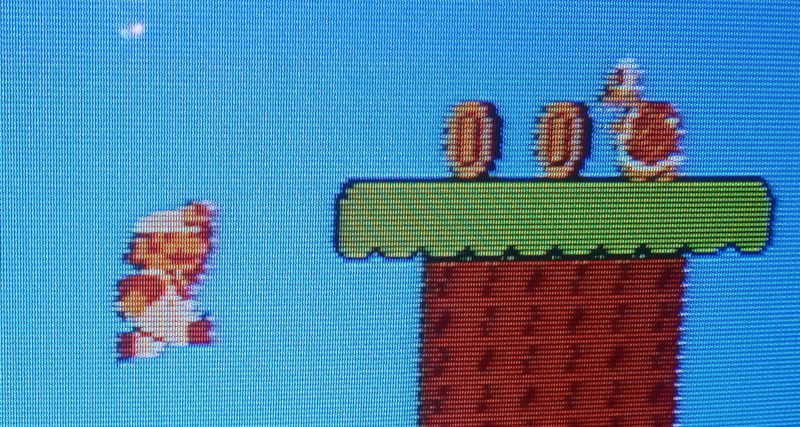
Super Mario Bros. (1985, Nintendo)
1958's Tennis for Two is often pointed to as the first video game. It's for all the usual reasons one would call it a video game, but most notably for the fact it was constructed for the sake of amusement instead of as an academic demonstration. I, personally, would consider it more in the spirit of a video game than any of the number of Tic-Tac-Toe simulators that preceded it, given the triviality of pulling out a piece of paper and just drawing a game board; at least for Tennis you'd have to gather some equipment and leave to find a court to play on. So there is some distance gained between the simulation and what is being simulated. What ties them together, however, is the fact that they're simulations of things that are already games.
With 1962's Spacewar!, the setting has already jumped two or three more stages beyond anything that exists in our real world, for it presents its players the opportunity to assume the role of one of two spacecraft engaged in a dogfight around a black hole. Herein lies another important first, though: in addition to the conflict between the two players, there is now a conflict internal to the game, that of the black hole pulling the players in while they fight. It's an environmental hazard, of the game world itself, not simply another player-controlled "game piece". The simplicity of the game, however, is inescapable; it can be conceived of as a really complicated version of an old electromechanical arcade game, of the pre-video arcade games. You have a single-screen setting and two players and that's all there is to it.
Fast-forward to 1981 wherein arcade games have fully taken root as an institution, most of them taking on space or sports themes, but with single-player experiences in which a player grapples with computer-controlled enemies being much more prominent among them. A complete narrative had scarcely, if at all, been attempted in this realm, nor had world sizes appreciably expanded beyond a single repeated playfield. In this environment we find Nintendo's Donkey Kong, whose theme is not subject to a one-phrase generalization like "you play tennis", or "you shoot down these aliens", and instead requires a more elaborate description that more or less resembles a plot: Donkey Kong has kidnapped Pauline and is ascending a large building still under construction, and Jumpman must chase after him and rescue Pauline, overcoming the construction-related obstacles in his path. These are all elements of the game that are shown, not told. The aesthetics too have been brought more concretely to the fore with attractive, cartoon-style graphics giving its characters a personality; the protagonist, objective, and opposition are each no longer so anonymous. There are stakes. Furthermore, this plot progresses in four distinct episodes, and the player is provided closure with a genuine ending. Donkey Kong by itself is a major step up for video game worlds, and was accordingly wildly popular. In the end, though, you've seen all the game has to offer in about five minutes, after which it loops back to the beginning to become a standard arcade score attack. It doesn't quite escape the trappings of the parlor games of old; you're never not aware that you're playing a game.
Parallel to the history of arcade games runs the history of computer role playing games, with titles like dnd and Rogue appearing in the 1970's. We can skip ahead here to 1985's Ultima IV: Quest of the Avatar by Origin Systems, where, leaving aside the truly novel themes it's most known for, we find a world whose size dwarfs that of any game that came before it, and whose mechanical complexity stands tall among any then-extant CRPG. Surely this is our fully-realized virtual game world, one is tempted to say. But no. For where it is lacking is in the depth of immersion it offers. Aesthetically just about everything is left to external materials and to the player's imagination, exemplified by the introduction sequence literally telling you to stop playing and go read the ~50 page story booklet that comes with the game. When it comes time to actually play the game we're greeted with extremely primitive-looking tile graphics, with none of the expressiveness of any of the arcade games that existed even several years before it. It's a game that begs its player to use their imagination, to do their own interpreting of the world's goings-on; a game where the only immediate control the player has of their avatar is jerky, tile-based movement, with all other functions relegated to commands assigned to just about every key on the keyboard. The barrier to mere entry, to say nothing of the actual difficulty of the game itself, is that of a towering wall of indirectness, only to be scaled by the truly dedicated. The player has to put in much work, work that is akin of both the kind and degree one puts in to play a tabletop RPG, to be immersed in a world otherwise breathtakingly realized for its time.
Let's now narrow the scope of our historical-critical apparatus, not to the actual subject of the essay, not yet, but at least to its direct antecedent: Namco's Pac-Land, released in 1984. It's a side-scrolling action platformer, taking place in a variety of settings, wherein the physics are nontrivial, with Pac-Man himself having an element of momentum in that his speed is dictated by how long a direction has been held. The environmental obstacles that he encounters take the form of small objects sitting in the path, and though the objects are of a theme with the rest of the stage (small stumps in the forest area, and so on) they aren't really organically designed into the level, and by this it's difficult to say that Pac-Land is really a platformer in the ordinary sense. Structurally the game offers a handful of stages that, while more substantial than those of the games preceding it, still efficiently fill the arcade game niche of not containing too much for the player to slow down and absorb. This is accentuated by the prominent and short timer and the ever-present ghosts giving chase; you're not meant to stay in one spot for long. Here we're still firmly planted in arcade game territory. But Pac-Land showed, to the artists attuned to see, the precipice above and away from a fertile landscape. Shigeru Miyamoto and Takashi Tezuka were just such artists, and now duly apprised, they set out to explore.
Of the two primary buttons on a Famicom controller, Super Mario Bros. dedicates one almost entirely to "run". It's not quite accurate to call it the "run" button, however, as Mario's speed can be changed in mid-air; it's a subtle but important distinction. The versatility allowed by this freedom of choice in speed infuses the platformer genre with an entirely new, higher level of depth of interactivity that persists in many 2D platformers made to this day. It's one of those "why weren't we always doing it like this" ideas. It's an incredibly simple mechanic with a very shallow learning curve, and coupled with the precision of movement that it effects, it makes controlling Mario, making the little man on the screen comply with your impulses, that much more immediate and direct. The momentum contained in just his walk speed is Pac-Land-like, but the curve so gently and smoothly leads into his run speed that at no point does the player feel like they're activating a different function. Running in SMB is not an event, it's a modifier. It cannot be overstated how much this game's greatness can be attributed to merely the momentum curve with regard to walking and running; it's astoundingly natural considering the games that came before it.
In the majority of precedent games where you can "make your dude jump," like Pac-Land, the jump is of a fixed height; you press the button down for any length of time and the height of the resulting jump is static, perhaps only truncated by an overhead obstacle. In many such games even your trajectory is fixed; Donkey Kong here is illustrative. This is realistic, as changing your trajectory in mid-air is, at best, extremely difficult to do in real life, and there is a place for this kind of mechanic and the careful planning in negotiating obstacles it requires, such as in the Makaimura series and early Akumajou Dracula games. But, leaving the particulars of level design aside for now, let us consider the jumping in conjunction with the running in Super Mario Bros. As we've just discussed, the run button modifies Mario's momentum in a wholly natural way, offering fine, precise control of his speed in nearly any state; jumping, here, is no different. The jump is not static, nor are there any clean delineated stages of jump height; it is precisely attached to the length of the button press combined with Mario's current speed, making walking, running and jumping a perfectly congruent activity. There isn't merely a smooth curve to Mario's acceleration, the curve is of Mario's overall movement. In the hands of an even only somewhat skilled player Mario runs, short hops on some enemies and then bounds over a long gap with all the grace of a professional gymnast, and nearly effortlessly on the part of the person controlling him. "Effortlessly" here not meaning by an unnatural, indirect "press a button to initiate cutscene" mechanism, but by offering a frictionless channel from the player's own intentions into the events on the screen with a heretofore unparalleled degree of accuracy and nuance.
This pinpoint accuracy is necessary in an overall design like SMB, that is to say, a design that is unapologetically console first. Stages are spread out and varied in a way that wouldn't accommodate stickier control mechanics, and the urgency with which an arcade game compels the player to keep moving has largely been left behind. There is a stage timer, but it is quite ample, and at very few points in the game is anything actively pursuing you and forcing you to move ahead. A player can take their time and really consider the environment around them; a pall of anxiety is lifted in this platforming game designed primarily for the home environment and intended to be purchased in its entirety at one instant. At the store you have obtained a miniature world; it is now yours, and you may explore it at your leisure. Even less important than the timer is the score counter, a wholly token addition that would persist for decades to come as a vestige in games with no genuine scoring system, and the addition of coins as distinct pickups with their own counter as a 1up mechanism drives the point home. One can, if they wish, stop at every moment to break every brick and pick up every coin and defeat every enemy all the way to the end of the game in order to make the score go higher, but without the usual urgency and inherently competitive nature of an arcade game this routine would seem completely opposed to what the game ostensibly offers.
To gain a full appreciation of this miniature world, we need to go on a(nother) small tangent for a moment to talk about the nuts and bolts of it. In SMB's day, a basic Famicom cartridge would come equipped with two rom chips: one for code, one for graphics. This neat division mirrors the setup of the Famicom itself, that features not only a CPU but also a graphics-specific processor dubbed the Picture Processing Unit, or PPU. This is what enabled the Famicom and its American counterpart, the NES, to obtain a graphical fidelity leaps and bounds ahead of the Atari 2600, despite both of them having (basically) the same CPU. Any and all of the fussy details of actually getting the tile graphics from the graphics rom onto the screen, something that's an absolute nightmare to program on the 2600, was abstracted away into a handful of PPU commands. However, there's a hard cap to how large a Famicom game can be with this model, somewhere in the neighborhood of 48 kilobytes. This is because the Famicom's architecture is memory-mapped, which means that any discrete thing that the Famicom's CPU can access will be accessed with a numbered address that's attached to it, from the state of controller inputs, to the PPU's features, to every individual byte in memory, and of course, to every byte on the ROM chips in the inserted cartridge. The Famicom utilizes a 16-bit address space, meaning that the maximum possible value for a given address is 65,536. If there's more than that number of discrete things theoretically available to the Famicom, tough luck, because there's no possible way for the processor to physically "see" it. It can't count that high.
With the hardware components of even a cartridge-less Famicom already taking up some of that space, we're left with that ~48 KB hard cap for the game. It's not that the ROMs on the cartridge couldn't be larger, it's just that there weren't enough addresses available to number more than the first 48,000 or so bytes, and therefore the CPU would have no way to know about them. There, of course, ended up being ways around this, ways that were already being utilized in other systems such as home computers, but ROM chips at the time were very expensive. It was thought at the time of SMB's development that the Famicom Disk System, utilizing floppy disks for game storage, was the future of game development for the platform. The FDS would simply read whatever data was on the floppy disk that was appropriate for the moment and swap it into a part of the address space the Famicom's CPU could see. In this way, a game could be theoretically limitless in size, maybe spanning multiple disks, given that the FDS peripheral was there doing all the legwork in giving the data it read the right addresses, and discarding anything it no longer needed. As the cherry on top, floppy disks were writable, allowing for an effortless built-in path to saving the current game state. Alas, the FDS hardware wasn't terribly reliable and ultimately was never released outside of Japan, and it didn't take long for the price of ROM chips to plummet anyway. At the end of its most fruitful years most cartridges were already utilizing something popularly known as a mapper chip, which wired into the Famicom's CPU and PPU by itself and acted as the intermediary between them and the game's now much larger ROM chips, much like the FDS was doing for its floppy disks.
All this to say that before the FDS was released and before in-cartridge mapper chips became financially feasible, there existed for the team at Nintendo an impetus to push the cartridge format as far as it could go, to create the best game they could possibly make within the constraints of that original hard-limited address space. With room to spare, they produced Super Mario Bros., a cartridge with a 32 kilobyte chip containing the game's code and level data, and a staggeringly small 8 kilobyte chip for all of the graphics in the game. Leaving aside for now the matter of the graphics, it is also quite the feat to contain 32 stages (8 worlds of 4 stages apiece) that span many screens, in along with all the other code in a mere 32 KB. This is a testament to the efficiency of the stage construction, evinced in part through basic logical rules and restrictions of object placement placed at the outset, e.g. one can only have this many objects in a single column of tiles, only this many moving objects can be present at once, and so on. Additionally, it is through a compact language of design within the code that levels are described, e.g. a particular pair of bytes means place a row of this length of these static objects here, obviating the necessity of having individual data for each individual object the player sees. With a consistent yet versatile layout mechanism available to the game's designers, the overhead of creating this miniature world was reduced to a near-atomic scale. Even more obvious space-saving measures are handled with grace and subtlety, in that while some stage layouts are used twice throughout the game, their re-uses are spread far apart, and their latter appearances have harder enemies. A casual player won't notice this little trick, and so the illusion of a large contiguous world is maintained.
Through this efficient design language we have a large set of levels whose elements never feel merely facilitative. Bricks and question-mark blocks hanging in the air aren't exactly natural constructions, but their multiple purposes help to align the game's mechanics and world. Lines of bricks allow Mario to reach higher and further places; Mario can hit a block with an enemy on top of it from underneath to send it to its doom; sometimes blocks that seem breakable actually contain a hidden item. No narrative contrivance is necessary for these constructions to exist (though the manual certainly tries) for the fact that they are thoroughly and utterly purposeful, and thus immediately feel like they belong to their world without the slightest of dissonance on the part of the player. Alongside these elements are fully organic constructions of floors, bridges, trees, and giant mushrooms that are of the world itself, but also are platforming challenges that never fail to fit Mario's superb capability of movement like a glove. I've said before in previous essays that good game design can be defined by the richness of a game's world and by how closely the mechanics fit it, and vice-versa; any superfluous elements on either side of the equation serve to weaken the overall experience. Of Super Mario Bros., we may as well say it is the ur-example of an expansive game world with tight design.
The structure of the game too is firmly in service of nothing but presenting a convincing, unfolding world. In Donkey Kong, there are four unique screens each with one or two basic obstacles repeated. One of the 32 stages in Super Mario Bros. will contain more unique obstacles than Donkey Kong in its entirety. Pac-Land consists of a looping set of around seven reasonably lengthy stages, while SMB contains nearly five times that many, with comparable variety. At the end of a world, what would be a loop demarcation in an arcade game approximately contemporary with SMB is now a continuation to the next world, not merely a signpost that the stages the player has just completed are about to be dealt out again but harder. The princess is in another castle, after all. An expression of a game world once consisting in a bite-sized adventure giving way to a never-ending score grind with only the theme of an adventure is here a flowing continuity. "Getting good at" Super Mario Bros. does not cross the ordinary player's mind; the player's motive force is their desire to see what else lies ahead.
As alluded to previously, games prior to and contemporary with SMB have had far larger apparent worlds, spanning towns and dungeons across entire nations. But where the computers that ran these games could crunch the numbers required to logically represent in some form this geography to the player, they did not have the requisite graphical power to make it truly convincing from an aesthetic angle. It's one thing for the mechanics of the game to be tight, but if there's nothing to immediately excite the senses then genuine, effortless immersion is impossible. The visual fidelity of Mario's world is necessarily lower than the best looking arcade games at the time, but all kinds of tricks are employed to effect a variety of themes and moods. One popular example is the clouds in the sky and the bushes on the ground using the same sprite with different colors. The same trick is performed for water and lava: What are all functionally ordinary holes in the ground are sometimes adorned with these backdrops, but the result is that, to the player, Mario is endangered alternately by water, lava, and bottomless pits. It would be a cheap and obvious trick indeed if pits were all there was to playing Super Mario Bros., but in this more comprehensive kind of platformer it dresses up a recurring element to successfully make it feel distinct as one component among many others. Stages will also alternate in background color to convey a bright clear day or a snowy night; through simple color changes Mario is not merely "doing another outside-themed stage," and some modicum of temporality is conveyed as well. These are all effective illusions, and the whole of art deals in effective illusions.
Film, at some point in history, achieved the distinction of "being art," of having a distinguished public profile alongside such established artforms as painting, sculpture, poetry, theater and music. Thus when someone poses the question, "are games art," admittedly something that's rarely asked in seriousness these days, they really mean, "can video games join the ranks of these already established artforms in terms of social standing?" Close behind this question is the perhaps even less often seriously posed, "where is video games's Citizen Kane," for the reason that Citizen Kane is emblematic of film's coming of age as an artform. The tricks it used largely weren't new, but its judicious use of all of them in the service of visual storytelling was. It's a film remembered as much for its visual trickery and story structure as for the content of the story itself, but moreover it's remembered for the coalescence and interdependence of all of these elements into a dazzling whole. It was nothing like a mere filmed stage play, nor would such a translation have anything of the goodness of the original; it utilized its medium with a robustness not yet seen. Film had fully crossed over from a kind of gimmicky high-tech replica of theater to an artform all its own. Surely by now you see where I'm going with this.
Super Mario Bros. runs right up against the limits of the technology it used to create illusion on a scale heretofore unseen in a game using any technology. It no longer bore any resemblance to the electromechanical arcade games of old, it required no indirection or externals for the player to be in the game, and what a new player saw and felt in 1985 upon starting it should have effected the kind of profound feeling given by an example par excellence of something less uncontroversially an artform. If it didn't, then, to put it bluntly, they were too out of touch to appreciate it. The influence of this game is larger than that of any other game that has ever been released; game developers worldwide suddenly realized that to make video games that are immersive worlds, one needs to divest them of the scaffolding of traditional games, electronic or otherwise, and make the logical distance between player and game as short as possible, to erase the existence of the control mechanism as cleanly as possible, to make the world as full and rich as possible. Super Mario Bros. does not represent so much a dramatic increase in degree of integration of aesthetics, mechanics, and a large world, but the first successful attempt at integrating them whatsoever. It is the first real video game, and Shigeru Miyamoto and Takashi Tezuka, artists in the truest sense of the word, showed the world how to make them.
5/5 (Great)