Limited Media
Much hay has been made across the broader online landscape about retvrning to "physical media", rejecting the convenience and non-convenience of streaming services, truly owning the art you purchase, with only the impermanence inherent to physical objects standing in the way of your enjoyment of it. And Hell, for many years now I've been on that bandwagon, my sole remaining streaming service subscription which I haven't logged into in ages being a result of my folks' continued use of it. But the offered benefits of physical media seem to be predominantly reactionary; going against the grain of the modern world's ever-increasing ease of data transfer and ever-decreasing control of said data by its beneficiaries. To be clear, more complete ownership is an advantage of physical media, and one that shouldn't be discounted; I seek out physical first for this reason. But contrary to what any given reader of this site may think of me, I'm not sitting around in my day-to-day fuming about big corporations' desire for me to own nothing and forever suckle from their vile teats, no, the most important benefit of physical media to me is more personal, and incidentally has nothing to do with physicality.
In short, it's having a sharply limited selection of things to choose from. Now I'm well aware that I'm far from the first person to espouse this particular point, it certainly comes up, but for me it's the #1 thing I like about keeping a mostly physical collection of video games and other entertainment. Many internet denizens of a certain age recount the days when, as children, they got a Birthday Game and a Christmas Game and that was that. It was prudent to ensure that they knew they would like the game they picked, and once they picked it, they would have no choice but to get their money's worth. Children being children, however, scarcely show such prudence, and so commonly with such stories come admissions that the games they picked often really sucked. Nevertheless, such a child would soldier on, 100%-ing Glover or some shit with their big sister, three times, before being able to draw again on the next significant gift-receiving holiday.
But while adhering to a strict diet of physical media places a much welcome drag on the over-proliferation of one's video game or film choices in the immediate moment, it surely doesn't stop it completely. As someone who is nominally an adult, I have great freedom not only in how I spend my free time, but also freedom in expanding my array of hows at will, through that insidious clutter generator known as the impulse buy. There are extra steps involved in acquiring new media if one goes full physical, either in going to a shop or waiting on an online order to arrive, but there's very little stopping me from buying ten cheap used games at once. There's scarcely any difference here from just using a Steam account normal-style, in terms of choice. The dreaded backlog remains.
Now, backlogs aren't bad for everyone, as there are many gamers out there who are perfectly content to just play what they want when they want, without regard as to whether they really plumb any particular game's depths. This is, in fact, certifiably normal-brained behavior. But there are many, such as myself, who if left unchecked, can decision-paralysis themselves right out of the hobby. It is for this reason I made two decisions.
The first is to significantly pare down the games I have immediately available in my collection. In one room, the one with the CRT television, I have a pile of "old school" consoles in one box, and a set of 8-12 games for each one in another box; this amounts to about 40 physical games. On my MAME psuedo-cabinet in the same room is a selection of about 15 arcade games. On this PC, also in the same room, are the Dolphin and Flycast emulators, giving me access to a small handful of GameCube, Wii and Dreamcast games, most of which I do own physically, but are difficult to access due to aging optical drives. Similarly, my PlayStation is modded to use an SD card, and it has about 10 games on it as well. Finally, in the living room I have a lone Switch with something like 18 games.
Maybe you're thinking, this is "significantly pared down?", but truly yes, it is. A huge amount of NES and SNES games sit in boxes along with half of the number of Switch games I actually own. Moreover, entire systems along with their games also sit in boxes, such as a PS3 and a PS4 and a couple of varieties of X Boxen. I intend to find good homes for all of this, uhh, eventually, but for now they are out of sight, out of mind. All told I have about 100 games readily available to play. The selection process for each system came down to one consideration: "Am I really ever going to play this?" This wasn't a terribly hard question to ask myself, eager as I was to get my available games down to a manageable size. This question also factors into my second decision: New games acquired per year, including purchasing physical media or adding a ROM to my collection, should equal to exactly 2.
Thing is, even having done all that, I still have a pretty substantial backlog of games I've barely touched, much less beaten. Looking back at all the games I've selected and all the games I've stowed away, it astounds me just how many games, like, exist. One person from a single digit age until their death, turning "beating games" into two full time jobs, couldn't work their way through even a fraction of all of them. Furthermore, we hit the point of diminishing returns in terms of graphical advancement likely over ten years ago; HDR and 4K and ray tracing are basically gloss compared to the brass tacks of creating efficient models and wrapping them in suitably high-res textures. One has been able to execute basically any artistic vision they have as long as it involves a screen and a controller for a long while now.
Combine all that with the huge overstuffed worlds that have long been the norm for AAA games, it begs the question of why these things even keep getting made. Don't we have enough games already? The answer to that of course is that while gaming nowadays is an extremely mainstream hobby, it's a slim minority that have wide reaching tastes and will play just about anything as long as it looks good. The "two games a year" thing is only a restriction for someone like me, whereas it seems to be the norm for most people who play video games:
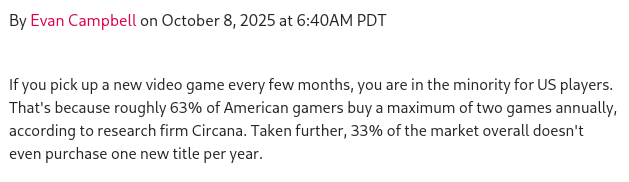
Indeed, if all you play is one flavor of sports game and Call of Duty, then re-upping yearly seems perfectly logical because by then you've played the last one to death. More than that, given these absurdly popular varieties of game are sequels in the truest sense, previous versions are effectively disposable. Most gamers aren't concerned with a "library"; they get "the new game" and every few years "the new system" and that's just their game for a while. I'm not even a stranger to this attitude, as last year I mostly played Tetris the Grand Master 4; I'm not exactly some renaissance gamer. It's just that, sometimes, I crave variety.
But with playing a game I haven't played before, or at least haven't played in a long while, there's this mysterious pressure to commit. "Oh, I don't know if I'm ready to start a whole JRPG right now." "Oh I have a save file on this game but it's been too long, may as well restart." It didn't used to be like this. It wasn't until I was nearly an adult before I got 120 stars in Super Mario 64, but when I was 7 years old I would still come back to it again and again, long after I had stopped being able to progress, just to run around and even re-do stars I had already done. Full 100% completion of any game seemed insurmountable to me as a kid; I was just happy to inhabit an impossibly grand and robust virtual world for a little while. It really did seem limitless. I can't hope to inspire that kind of childlike naivete in myself as a 36 year old woman, I've seen behind the curtain, I know too much, but I can still approach gaming at least to some degree as spending time in another world, even if I know ahead of time the limits of it.
In a game where arcade rules apply, I can play and play and play again, increasing my skill in both survival and scoring. In longer more freeform games I can play until I've winnowed out every last morsel of content, then do it all again the next year. A good game should stand up to repeated play. I can approach film and television with the same attitude: watch a movie on Bluray one night, then go through its special features the next night, and look up even more interesting tidbits online. And then I can watch the movie again some time later, and repeat until it's fully assimilated into my soul. This is what I used to do with my DVD collection as a teenager, before the current day deluge of available-at-your-fingertips media wherein everything is disposable. I developed a relationship with these games and films (and shows and music and...).
So, in sum, physicality is incidental to my aim here. My time allocated toward the appreciation of all these art forms should be spent engaging with their best possible examples, or at least, those that are the most plainly appealing to me. The importance of this is increased by the fact that much of my free time is already allocated toward creative hobbies, such as writing, or making music, or *shudders* programming. When the number of choices I have in media to engage with grows to an overwhelming amount it becomes impossible to foster that kind of deep, satisfying familiarity with any of it. In childhood this familiarity is born of a sense of wonder that leaves as one ceases being a child; along with it leaves the time dilation that results from each experience, more often than not, being a novel one. Once these are gone, they're gone for good, barring the presence of some mental abnormality. Only the restriction of choice, although here with conscious effort, can be replicated.
One could, to some degree depending on one's life situation, also replicate the copious amounts of free time dedicated to just playing video games, watching movies, and so on. But as an adult, I've developed a much more demanding creative urge, one that precludes such an expenditure of said free time. The more I create the more I feel emboldened to continue creating, less inhibited, more confident that what I do has some kind of value. It's not that I have less time, but also less interest, in sitting down to play games and watch movies and listen to music for hours and hours. There's somewhat of a misguidedness to this nostalgic exercise, in that I don't really want to go back to the days when I would put on some headphones and listen to albums back-to-front, really focusing on the music, or watch movies back-to-back, or play through Zelda games in huge 10 hour chunks at a time. I did have fun back then, and things were simpler, but in this I acquired both the taste for these various works of art and the drive to create some of it myself. It is mostly for the better that my life has become more complex.
To create effective art requires that one experience life (this is, incidentally, the key point as to why LLMs within their server rack prisons will never be able to create genuine art). Fortunately, life does include the art of others, and indeed experiencing that art is quite helpful in one's own creative pursuits. So never will there come a time in which I'm simply too busy to immerse myself in someone else's world for a little while. The time has come, though, for me to be a bit more particular about which worlds I choose.